
The NASCAR season is over. Let’s review how the race and playoff simulation models performed, and would have performed over the course of the playoffs. Over the course of the playoffs, I’ve improved both the race and playoff simulations, and have not updated previous articles – so the results presented below will not align with the results presented previously. To maintain some consistency, I’ve gone back and re-run the simulation for every race after every race, and then run the playoff simulation with those simulations.1 First, how the driver’s probability of advancing changed over the course of each race.
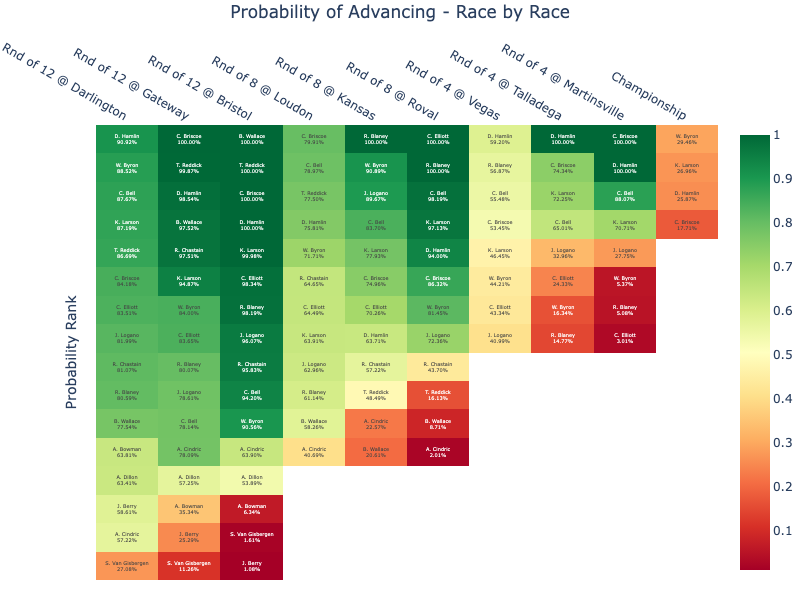
So, how did the simulation do? Looking at the predictions of who will advance at the first race of each round, and comparing it to who actually advanced: in the Round of 16, it incorrectly predicted that Bowman would advance and that Cindric would be eliminated; in the Round of 12, it incorrectly predicted that Logano and Blaney would be eliminated, and that Reddick and Chastain would advance; and in the Round of 8 it incorrectly predicted that Byron and Larson would be eliminated, and that Blaney and Bell would advance. For the Round of 16 and Round of 12, and for Blaney/Larson in the Round of 8, it had recalibrated and predicted correctly after the first race of the round, only carrying forward inaccurate predictions into the final race of the round at Martinsville, predicting that Bell would advance over Byron. Before we dive deep into each of these drivers’ rounds and why the model erred, let’s take a look at how the ranking of championship probabilities evolved over the playoffs.
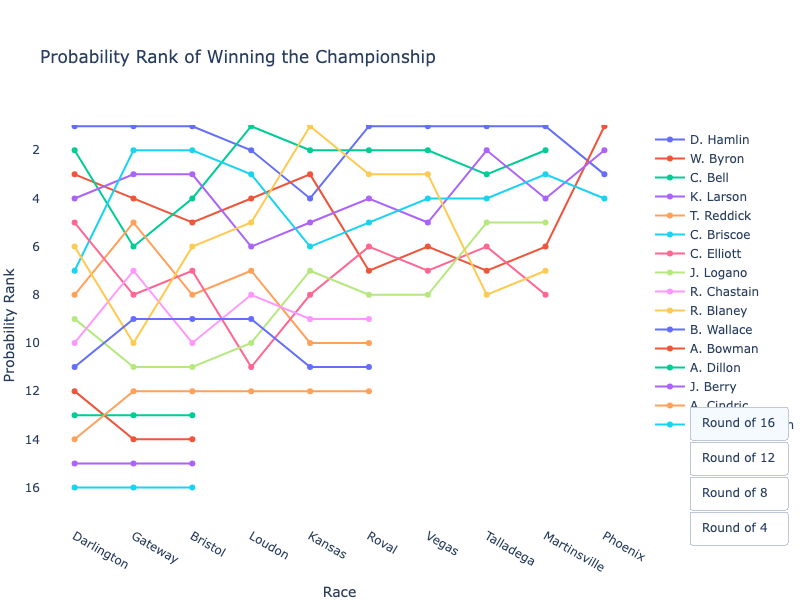
The eventual Round of 4 drivers started the playoffs between 1st and 7th, most likely to win the championship, and never dipped below 7th throughout the subsequent rounds. Larson had a bumpy playoffs – he was never the most likely driver to win, and dropped as low as 6th most likely at Loudon; his probabilities show HMS’s struggles, and subsequent focus on tracks like Phoenix. Hamlin held the most likely spot for 70% of the playoffs, partially due to his high probability of advancing in each round, but also because of his predicted performance at Phoenix. Byron scraped by through the second half of the playoffs – sitting in the bottom of the rankings through the Round of 8, of course, impacted by his rough finish at Vegas. Briscoe started out the lowest of the championship four, partially due to his win at Darlington. Bell and Blaney held high rankings throughout the playoffs. Blaney’s hopes were dashed by his early exit at Vegas, while Bell fell victim to Byron’s win.
Round of 16 Misses
The model had one miss in the round of 16, expecting Cindric to be eliminated and Bowman to advance. Let’s review their expected vs actual performance in the 1st round to understand what went wrong.
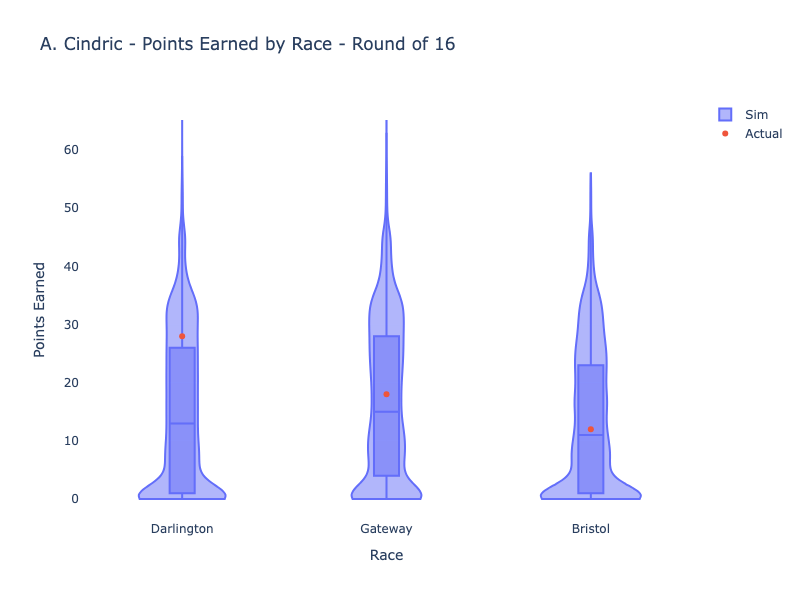
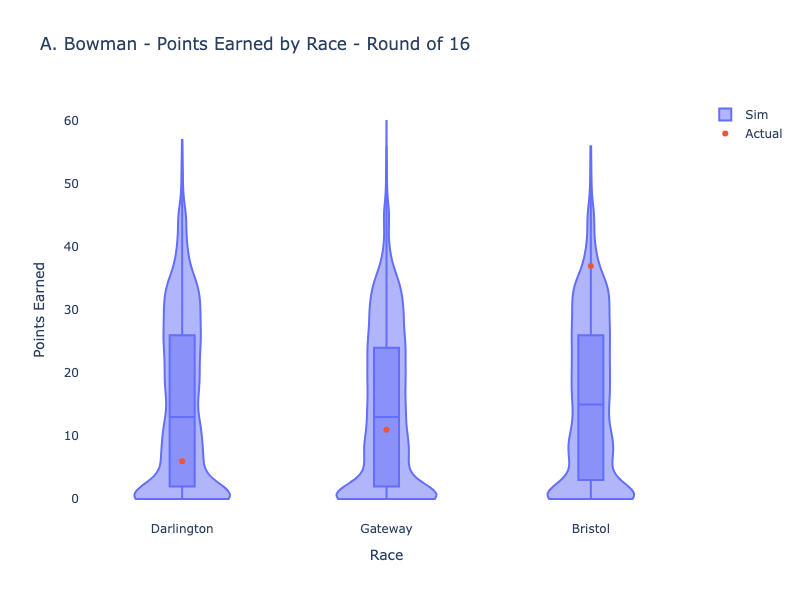
Darlington is where everything went off the rails. Cindric significantly overperformed his expected performance, while Bowman significantly underperformed. This put Cindric comfortably above the cutline, while Bowman floundered far below it. The trend continued at Gateway, with Bowman again performing below his expected result, and Cindric performing above his expected result. Bowman’s outstanding and well-above-expectation performance at Bristol got him close to flipping the script, but Cindric’s slightly above-expectation performance saved him from elimination.
Round of 12 Misses
The model had two misses in the Round of 12, expecting Blaney and Logano to be eliminated, while expecting Chastain and Reddick to advance.
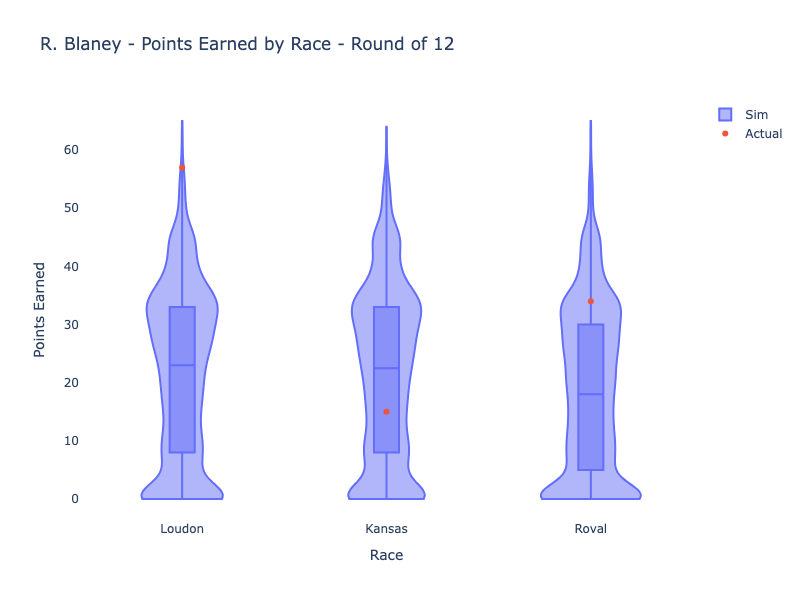
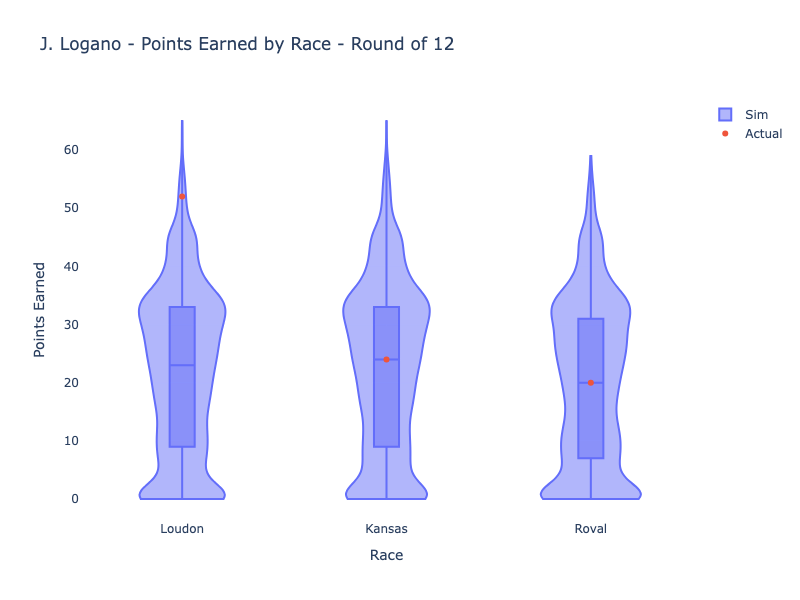
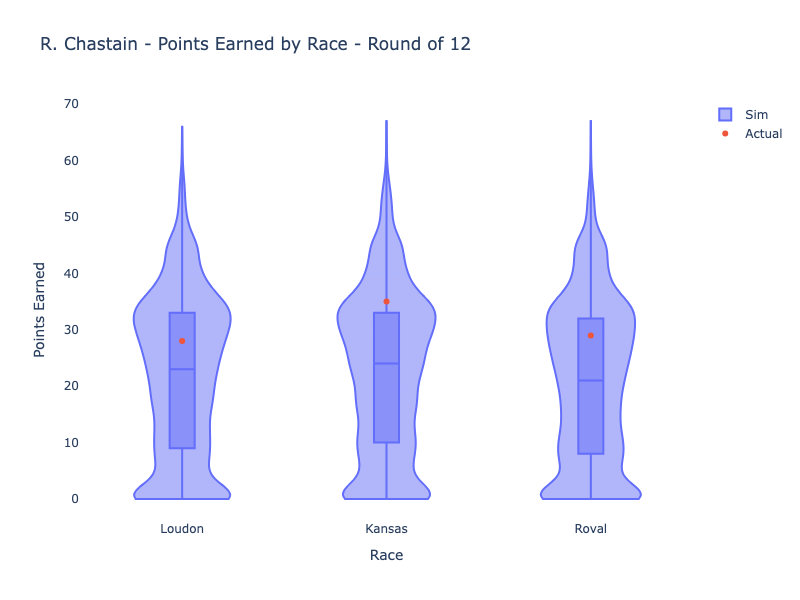
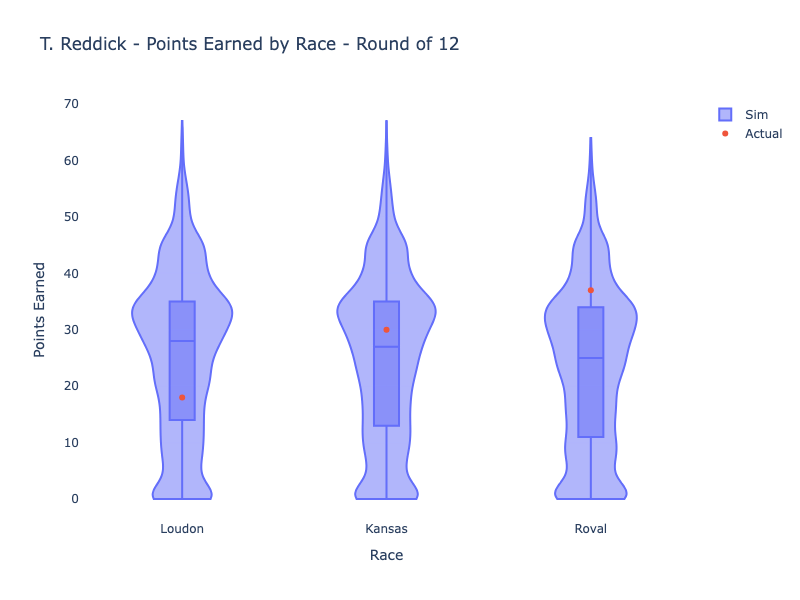
The story of this round is more interesting, as it’s different for each driver. Blaney effectively ‘stole’ Chastain’s spot with his win at Loudon, saving him from a significant underperformance at Kansas. Logano‘s incredibly strong performance at Loudon boosted him up, allowing him to turn in exactly median performances at Kansas and the Roval. While Chastain had a strong Round of 12, performing above expectations in all three races, his spot on points was taken by Blaney. Reddick struggled at Loudon, finishing at the bottom of his expected results, and while above-expectation performances at Kansas and the Roval kept him close, they weren’t enough to get him through to the Round of 8.
Round of 8 Misses
The model again had two misses in the Round of 8, expecting Larson and Byron to be eliminated, while Blaney and Bell were expected to advance
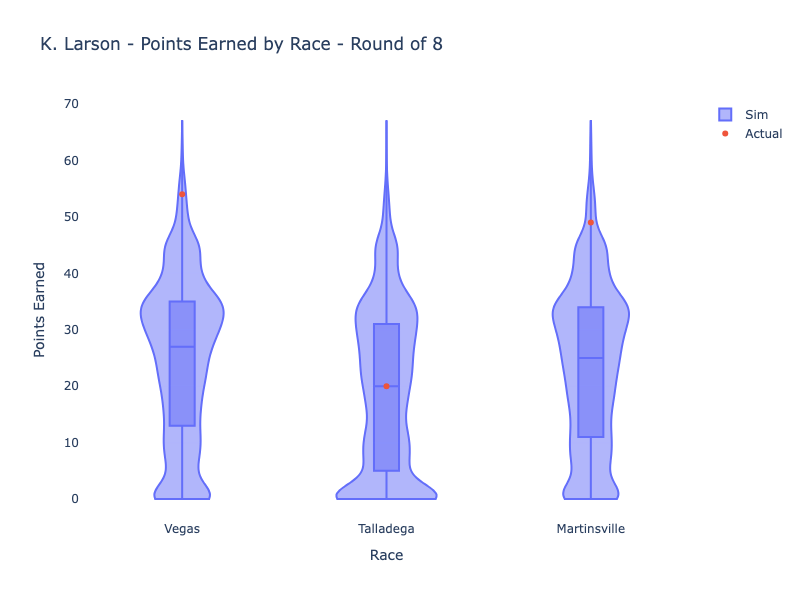
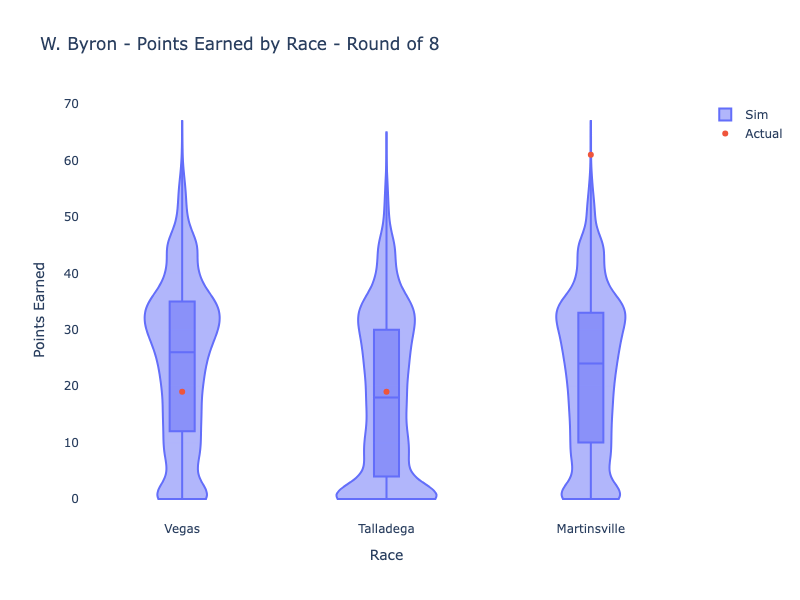
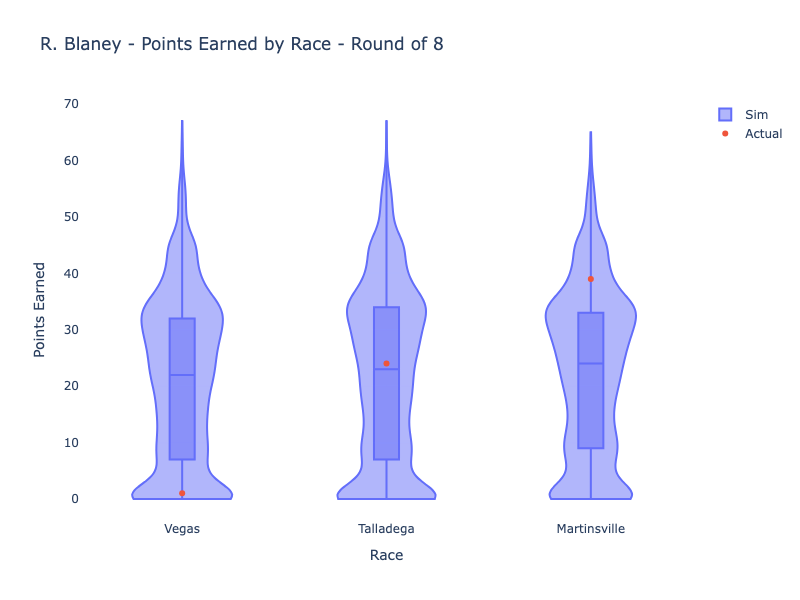
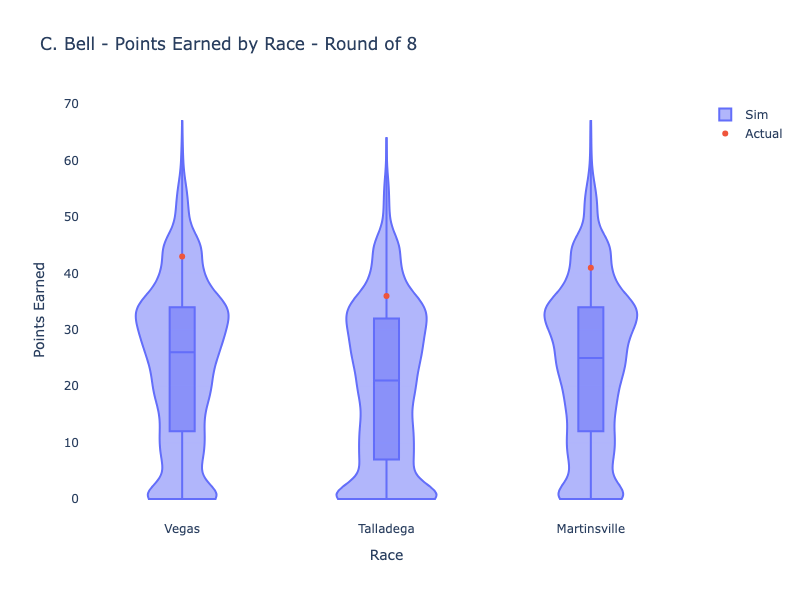
Larson and Blaney and Byron, and Bell pair nicely with each other. Larson significantly overperformed at Vegas, while Blaney wrecked in the first stage, earning just one point; both drivers then performed almost exactly as expected at Talladega, and overperformed at Martinsville, but that one divergence in performance at Vegas was enough to make the difference. In contrast, Byron and Bell is the story of a clutch win. Byron underperformed at Vegas and performed as expected at Talladega, while Bell overperformed in both races. Byron’s win at Martinsville stole Bell’s spot on points, leaving him out of Phoenix.
Overall, I’m happy with the performance of the two models – while it wasn’t perfect, it was only wrong because of extremely strong/weak performances, and save for the last round, each driver it was wrong about still had a >50% chance of advancing at the start of the round.
This has been a fun project, and will almost certainly not exist in its same form next year – we’ll see what NASCAR decides to do with the playoff format going forward.
- Some more detail for the nerds; for each race in the playoffs, race simulations were run for each subsequent race, only using data that existed at the time of the nominally upcoming race, so as to create an accurate simulation at that point in time of the season (as the race model has a momentum parameter that’s impacted by recent results) meaning that for this data each race is simulated multiple times; once for each prior race in the playoffs – resulting in 50 race simulations in total. ↩︎
Leave a Reply